
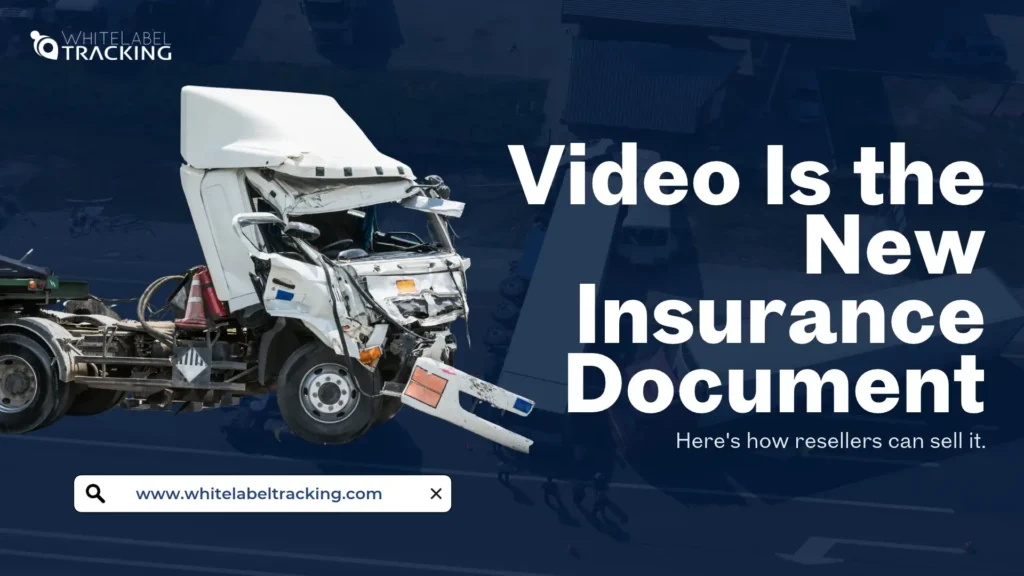
For years, fleets bought cameras for one reason: to settle arguments after an accident. That reason hasn’t gone away, but the buyer has changed.
Today, insurance is the strongest driver of video telematics. Fleets want lower premiums and faster claims. Insurers want better data on how vehicles are really driven. Brokers want clients who are easier to place and renew.
Telematics service providers sit in the middle of all three. They install the devices, run the platform, and hold the data. Since 2010, WhiteLabel Tracking has been the rebrandable platform behind that position for providers worldwide, from start-ups to telcos, government entities, and tracking service providers.
Video is now part of that core platform. This article explains why insurers care, what a sellable video package looks like, how to take it to market in Africa, and what the platform underneath it needs to do.
Why insurers care about video now
Commercial motor insurance has long been priced on a thin set of facts: vehicle type and value, cargo, routes, and past claims. None of it shows how a specific fleet is driven day to day.
Video telematics fills that gap in two ways.
It settles fault quickly. A time-stamped clip, matched to GPS position and speed, answers most “who hit whom” questions in minutes. That cuts assessment costs and protects fleets from false or inflated third-party claims.
It shows risk before a claim happens. Modern dashcams detect risky events on the device itself: harsh braking, tailgating, lane departure, phone use, and signs of fatigue. Counted over weeks, those events become a picture of how safely a fleet drives, and whether it’s improving.
The commercial effect is showing up in industry reporting. One 2026 industry guide puts typical premium reductions for fleets using video telematics at 5–15%, with faster claims handling when footage is available (FleetRabbit). Those are vendor-reported figures from mostly North American fleets, so treat them as direction, not a promise. But the direction is clear: insurers increasingly treat video data as part of how they judge a fleet.
What the evidence actually looks like
A clip on its own is useful. A clip in context is what insurers and fleet managers actually need. A good video telematics setup delivers:
- The event clip: road-facing, driver-facing or both, covering the seconds before and after the trigger
- The location and speed trace: where the vehicle was, how fast it was going, and the route leading up to the event
- The driver record: who was driving, their recent event history, and their safety score
- The event type: what the camera flagged (collision, harsh braking, distraction, fatigue) and when
When all four sit on one screen, an incident review that used to take days of phone calls becomes a five-minute job. That is also why buyers increasingly prefer video that lives inside their tracking platform, rather than in a separate camera app.
The product: sell evidence, not cameras
A dashcam sold as hardware is a one-off sale with thin margins, easy for the next supplier to undercut. The durable business is a monthly/annual service built around the evidence. Most resellers can package it in three tiers.
| Package | What could be included | Main buyer |
| Evidence | Road-facing camera, automatic upload of collision and harsh-driving clips, on-demand video retrieval | Fleets worried about disputed accidents and false claims |
| Safety | Dual-facing camera with in-cab fatigue and distraction alerts, driver scores, monthly safety report | Fleets with a driver safety or duty-of-care programme |
| Insurer-ready | Safety tier plus a standard claims evidence pack and periodic risk reporting in an agreed format | Fleets negotiating renewals, and insurers or brokers running a partner scheme |
Each tier is a per-vehicle monthly/annual fee on top of tracking. Because every vehicle you already track is a potential video upgrade, the product grows your revenue per customer instead of needing new logos.
Making it work on African roads
Three practical issues decide whether video telematics succeeds locally.
Data costs. Streaming video all day from every vehicle would wreck the business case. The right approach is to record continuously to the camera’s local storage, upload only flagged events automatically, and pull other footage on request. Data spend then follows the number of incidents, not the hours driven.
Patchy coverage. Long-haul routes lose signal. Cameras should hold clips and upload them when the vehicle reconnects, so evidence isn’t lost between towns.
Driver trust and privacy. Driver-facing cameras record people at work. Under Kenya’s Data Protection Act, 2019, fleets need a lawful basis, clear notice to drivers, and sensible limits on who can view footage and for how long. Position cameras as protection for drivers: in many disputes, the clip proves the driver was not at fault. Role-based access to video, so only the right people can view or download it, supports both trust and compliance.
Taking it to insurers: a pilot playbook
You don’t need a national partnership to start. A focused pilot builds the proof insurers want.
- Pick one pilot fleet. Choose a customer with a clear accident or claims problem and a manager willing to share results.
- Set a baseline. Record the fleet’s last 12 months of incidents, claims, and settlement times before cameras go in.
- Run 90 days. Deploy the Safety tier, coach drivers on flagged events, and track event rates month by month.
- Build the evidence pack. For every incident in the pilot, produce the clip, trace, and driver record in a standard format.
- Take the results to the broker first. Brokers can open doors to underwriters and are motivated by stronger renewals.
- Propose a partner scheme. Ask the insurer for preferred terms for fleets on the Insurer-ready tier, in exchange for structured risk reporting.
The goal of the first pilot isn’t a large contract. It’s a documented case you can reuse with every insurer and fleet you speak to next.
Why leading providers build video on WhiteLabel Tracking
The platform underneath decides whether a video offer scales. We’ve built the platform for service providers for over 15 years, and video telematics is part of the core platform, not a bolt-on.
- Any camera, one dashboard. The platform supports more than 2,000 tracking devices. Video works with leading camera brands including Hikvision, MettaX, Jimi IoT, Howen, Teltonika, Huabao, Queclink and Meitrack.
- Neutral by design. WhiteLabel Tracking sells software, not hardware. There is no device to push, so you choose cameras on price, quality, and local availability.
- Evidence built for claims. Live streaming, historical playback, and event-based video retrieval sit next to GPS, speed, and driver data. Crash detection from G-force data and crash reconstruction for first notice of loss (FNOL) give insurers a clear account of what happened.
- Privacy and control. User roles and permissions decide who can see footage, and live streaming is blocked on shared devices. The platform meets recognised security and privacy standards, including GDPR.
- Infrastructure that scales. The platform runs on multiple cloud providers, with more than 70 servers across regions.
- Your brand, end to end. The web app, mobile apps, and admin panel are fully rebrandable. API and data forwarding let you share risk data with insurers in the format they need.
The platform keeps moving, too. Version 92, released in September 2026, added live and historical video for a wide range of new camera brands, two-way intercom on supported cameras (in beta), and a refreshed interface across the web app.
If you’re a telematics service provider ready to add video, start a free trial or talk to our team for a walkthrough of the claims workflow.