
Every fleet and asset-heavy operation eventually runs into the same blind spot: the moment a vehicle pulls into the depot, a piece of equipment gets wheeled into a warehouse, or a tool gets carried indoors, GPS visibility disappears. Outdoors, satellite tracking tells you exactly where everything is. Indoors, most businesses are back to clipboards, radios, and someone walking the floor to find what they’re looking for.
That gap is exactly what we’ve closed. WhiteLabel Tracking now supports indoor asset tracking powered by mesh networking technology in collaboration with Teltonika’s Wiremesh Beacon and Sensor technology, giving our customers and reseller partners continuous, room-level visibility that picks up precisely where GPS leaves off; all inside the same platform they already use to manage their vehicles and outdoor assets.
The problem with tracking things indoors
GPS was never built for indoor environments. Concrete walls, steel structures, and multiple floors all block or distort satellite signals, which is why so many operations lose visibility the second an asset crosses a threshold.
The usual standard Bluetooth Low Energy (BLE) beacons paired with a fixed tracker or gateway helps, but it doesn’t scale gracefully. Every beacon needs to stay within a few meters of a gateway or tracker to be seen, which means covering a large warehouse, hospital, or distribution center requires gateways in nearly every room. That gets expensive fast, and it creates a fragile system: if one gateway goes down, you lose visibility into everything that depended on it.
The cost of getting this wrong is well documented. In healthcare alone, industry research shows more than a third of nurses lose at least an hour per shift searching for equipment, hospitals typically over-purchase mobile equipment by 10–20% simply because they can’t see what they already have, and 10–20% of mobile assets go missing or are stolen over their working life. Warehouses and factories see the same story in different clothes: misplaced pallets, “lost” tools, and idle time spent searching instead of working.
What mesh technology changes
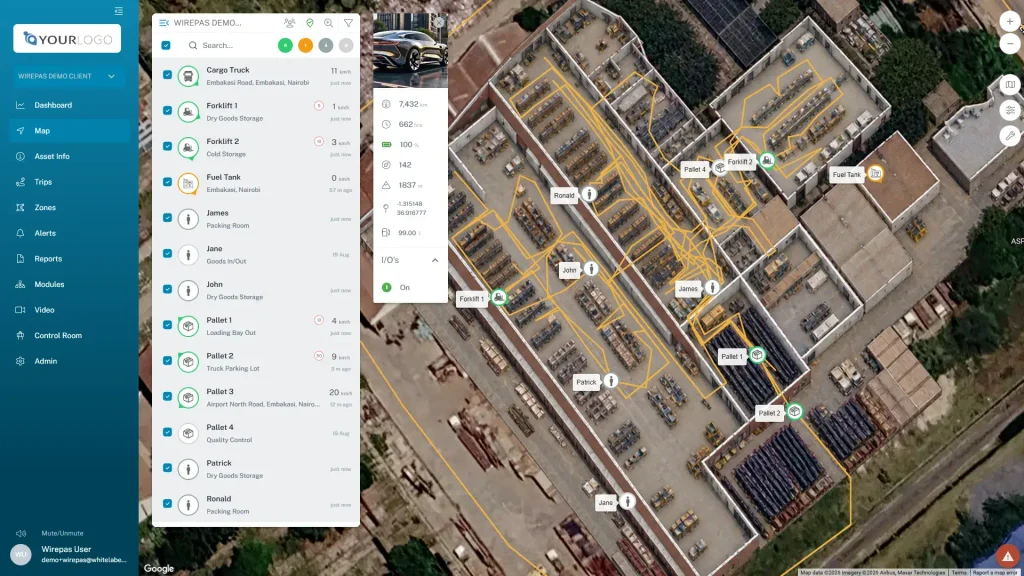
Instead of every tag needing a direct line to a gateway, a mesh network lets tags, anchors, and gateways relay data to each other, hop by hop, until it reaches the platform. Think of it less like a single spoke-and-hub radio system and more like a self-organizing relay team- every device can help pass information along.
That difference sounds technical, but the practical impact is significant:
It scales without a gateway explosion. A single mesh network can support thousands of tags across an entire facility or multiple buildings using a fraction of the gateways a traditional BLE deployment would need.
It heals itself. If a device drops offline or a signal path gets blocked, the network automatically reroutes data through nearby anchors. There’s no single point of failure and no truck-roll required to fix a dead zone.
It goes where GPS and plain Bluetooth can’t. Multi-floor buildings, basements, cold storage rooms, underground facilities; anywhere satellite signals can’t reach and simple point-to-point Bluetooth would need too much hardware to cover.
Batteries last for years, not months. Because tags aren’t constantly straining to reach a distant gateway directly, battery life on mesh-connected tags can stretch up to a decade depending on how often they report in.
How it works, in practice
The system we’ve integrated is built on three simple components, and none of them require your team to become network engineers to deploy:
- Tags are attached to the equipment, vehicles, or tools you want to track. They activate automatically, no manual setup required, and depending on the tag type, can report identification, location, motion, and even temperature and humidity.
- Anchors are small, battery-powered, wireless devices mounted around your facility that act as fixed reference points. Because they’re wireless and don’t need a SIM card, they’re easy to install and just as easy to reposition if your layout changes.
- Gateways collect data from the anchors and tags nearby and pass it up to the WhiteLabel Tracking platform, where it shows up alongside the rest of your fleet and asset data. Same login, same dashboard, same reporting your team already knows.
Position is calculated by triangulating a tag’s signal against at least three anchors in range, which typically delivers room-level accuracy; precise enough to know an asset is in bay 4 or on the third floor, without requiring the kind of expensive, high-precision infrastructure that’s usually reserved for specialized real-time locating systems.
Because everything runs through the same platform your team already relies on for GPS fleet tracking, there’s no separate login, no second app, and no disconnected spreadsheet to reconcile. Outdoors, your vehicles report their position over GNSS. The moment they or the equipment inside them move indoors, mesh tracking takes over, and visibility never actually stops.
Where this matters most
This isn’t a niche add-on. It’s built for the environments where “we don’t actually know where that is” costs real time and real money:
Warehouses and distribution centers. Track pallets, forklifts, reusable containers, and tools across a facility in real time, and stop losing labor hours to searching.
Healthcare facilities. Locate mobile medical equipment (wheelchairs, infusion pumps, ventilators, beds) the instant it’s needed instead of after a ward-by-ward search. Sensor-equipped tags can also monitor conditions for sensitive equipment and supplies.
Manufacturing and industrial sites. Keep visibility on tools, work-in-progress, and mobile machinery across a plant floor, including areas where GPS has never worked.
Cold chain and logistics. Combine location tracking with temperature and humidity monitoring to maintain compliance on sensitive goods as they move through a facility, not just while they’re on the road.
Logistics hubs and mixed fleets. For operations already using WhiteLabel Tracking to manage a vehicle fleet, this closes the last gap giving full accountability for assets whether they’re on the road or sitting in a yard, depot, or warehouse.
What this means for our reseller partners
For partners running whitelabel deployments, this is a new, sellable capability that doesn’t require a separate vendor relationship, a separate contract, or a separate support line for your customers. It’s the same platform, the same commercial terms structure you already operate under, with a new category of use case you can now bring to prospects who’ve outgrown clipboards and manual counts particularly in warehousing, healthcare, and manufacturing verticals where indoor visibility is a recurring, expensive pain point. If you have customers who’ve asked “can you also track things once they’re inside the building?”, the answer is now yes.
Mesh tracking vs. GPS vs. standard Bluetooth: what’s the actual difference?
It’s a fair question, since all three get lumped together as “tracking.” Here’s the honest breakdown:
GPS/GNSS is unmatched outdoors with accuracy to a few meters over open sky, and it’s what powers the vehicle-tracking side of the WhiteLabel Tracking platform today. It effectively stops working indoors or underground, which is the whole reason indoor tracking exists as its own category.
Standard Bluetooth beacons are a solid, low-cost option when an asset stays close to a fixed tracker or a vehicle. Think tools in a van, cargo in a single trailer, or a badge near a doorway reader. The tradeoff shows up at scale: each beacon needs a receiver within a few meters, so covering a large, multi-room facility means installing a lot of receivers, and the system has no way to route around a dead one.
Mesh-networked tracking takes the same low-power tag hardware and adds the ability for devices to relay each other’s data across a facility, so one network of anchors and a handful of gateways can cover a building — or several buildings — that would otherwise need a receiver in every room. It’s the difference between “tracking near a point” and “tracking across a space.”
None of these replace the others — they solve different parts of the same problem. That’s exactly why we built this as an extension of the existing platform rather than a separate product: your team gets GPS outdoors and mesh indoors, in one place, instead of stitching together two vendors.
Frequently asked questions
Does this replace our existing GPS fleet tracking? No. It runs alongside it. Vehicles and outdoor assets continue reporting over GNSS exactly as they do today; indoor tracking simply picks up once something moves out of satellite range, inside the same platform and dashboard.
How much infrastructure does a facility need? Far less than a traditional Bluetooth buildout. Most sites need a small number of gateways (often one per floor or zone) plus battery-powered, wireless anchors placed throughout the space. No SIM cards, no wired runs, and anchors are easy to reposition if your layout changes.
How accurate is the location data? Typically room- or zone-level accuracy — enough to know which bay, ward, or floor an asset is on. It’s a facility-visibility tool, not a centimeter-precise locating system, and it’s priced and deployed accordingly.
Can it monitor conditions as well as location — like temperature for cold storage? Yes. Sensor-equipped tags can report temperature, humidity, and motion alongside location, which is particularly useful for pharmaceutical, food, and cold-chain applications that need both “where is it” and “was it kept in range.”
What happens if a device or anchor goes offline? The network reroutes around it automatically. Because tags and anchors can relay through multiple paths rather than depending on one gateway, a single failed device doesn’t create a blind spot.
Getting started
Indoor asset tracking is available now as part of the WhiteLabel Tracking platform. If you’re a partner looking to bring this to your own customers, or evaluating WhiteLabel Tracking for the first time, we’re happy to walk through how a deployment would look for your specific site.
Contact us today, and we’ll help you get started!