
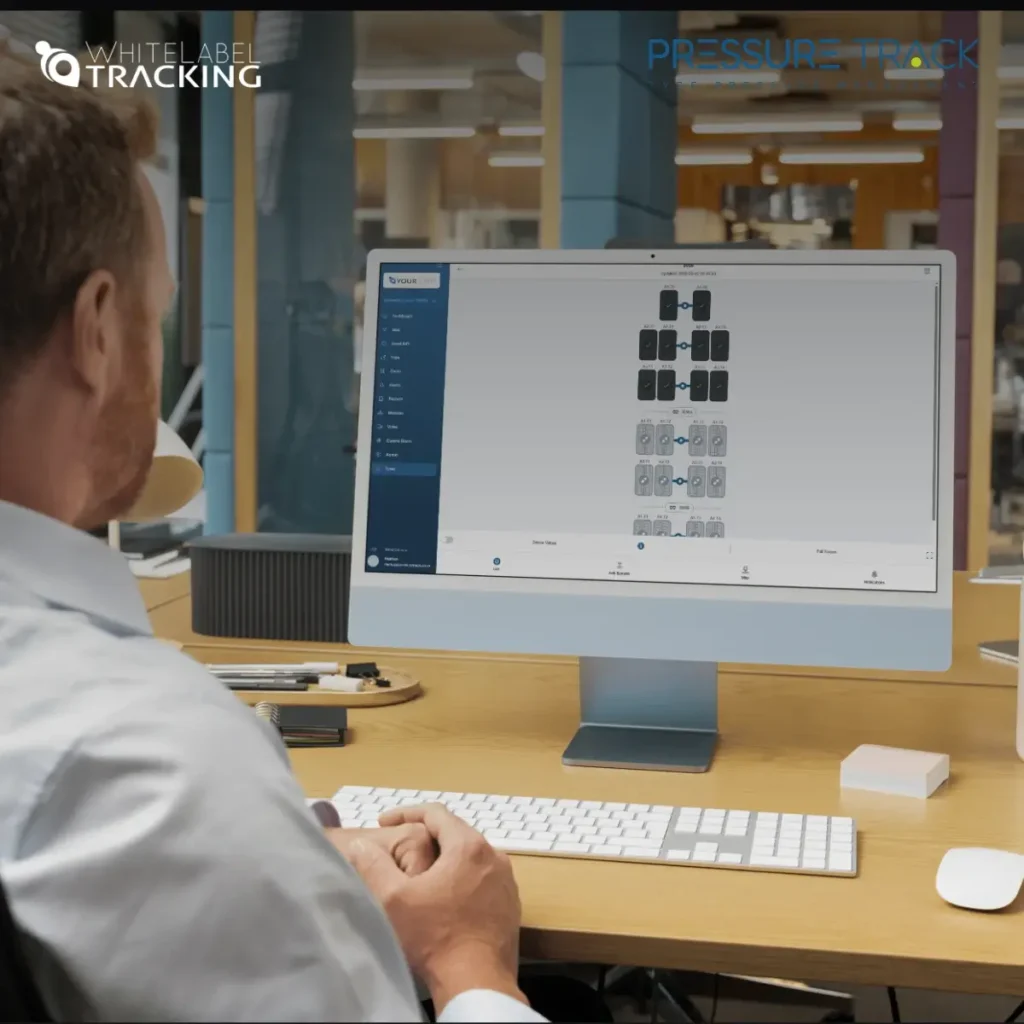
We now support tyre pressure monitoring on our platform, built in collaboration with Pressure Track — and it closes one of the last real blind spots in fleet management.
Ask most fleet managers how many vehicles they run, and they’ll tell you instantly. Ask them what’s happening inside tyre A2-T3 on trailer six, right now, and you’ll get a shrug. That gap — between how precisely we track a vehicle’s location and how little we know about the tyres carrying it — is where a huge amount of avoidable risk quietly accumulates. Tyres are the second-biggest running cost in road transport after fuel, and for most fleets they’re still managed the way they were forty years ago: someone walks the yard with a gauge, writes numbers on a clipboard, and hopes nothing goes wrong before the next check.
That’s the gap this integration is built to close.
The Problem Every Multi-Trailer Fleet Knows Too Well
Here’s a scenario that will feel uncomfortably familiar if you run anything larger than a single rigid truck: a standard truck-tractor and trailer combination — a common sight on the highways — running 28 wheels across both units. With a traditional tyre pressure monitoring system, a handful of basic questions become surprisingly hard to answer. Which sensor reading belongs to which wheel? Which trailer is coupled to which truck today, given that trailers get swapped constantly between vehicles and routes? After a flat, which wheel was it, and which spare replaced it? If two wheels get swapped during a service, does the system even notice?
A Genuine World-First: Sensors That Know Where They Are
This is the part of the Pressure Track system worth pausing on, because it’s a real engineering breakthrough rather than a marketing phrase. Each wheel sensor can independently work out:
- Whether it’s mounted on the truck or a trailer, and which trailer specifically
- Which side of the vehicle it’s on
- Which axle it’s mounted on
- Whether it’s an inner or outer position on a dual-wheel setup
- Whether it’s a spare
No manual position-mapping. No reconfiguration after a trailer swap or a wheel rotation. When a wheel moves, the system simply knows where it went. For any fleet running trailers that get shuffled between trucks — which is most of them — this removes the single biggest source of TPMS configuration errors and turns installation into genuine plug-and-play: no specialist tools, no wiring runs between truck and trailer, and in most cases, no technician visit required at all.
What the System Actually Monitors
Once installed, the internally-mounted wheel sensors (protected inside the tyre cavity rather than bolted externally, where they’re vulnerable to theft and damage) continuously track:
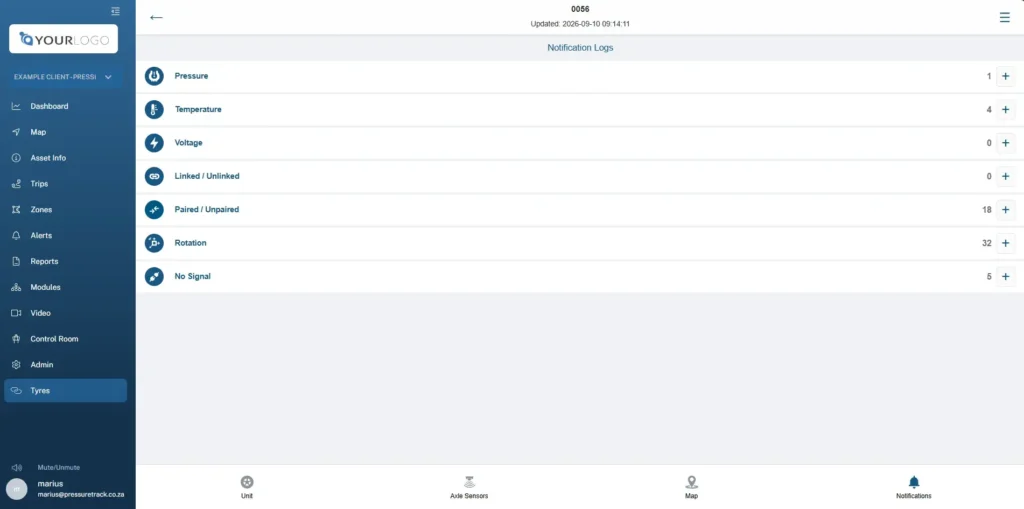
- Pressure, with fast-deflation alerts triggered on sudden loss
- Temperature, including heat detection tuned to catch brake and bearing failures before they become tyre failures
- Tread depth, rotation status, and motion data
- Battery health of each sensor, so nothing silently goes dark
Data flows to a cloud dashboard on a short update cycle and stays on record for easy review, accessible from any internet-connected device — desktop, laptop, tablet, or the mobile app, whether you’re monitoring five vehicles or a large fleet. Role-based access means an administrator sees the full fleet configuration, a driver only sees their own vehicle’s active alerts, and everyone in between gets exactly the view their job requires.
Beyond Monitoring: Managing the Full Tyre Lifecycle
What separates this from a basic pressure sensor is what happens to the data afterward. Every tyre gets its own digital identity — tracked by tyre ID, RFID tag, or serial number — from the day it’s fitted to the day it’s retired. That record captures individual kilometres travelled, remaining tread life, and retread and repair history.
That’s the quiet revolution here. Fleet managers have historically had to estimate how a tyre brand, supplier, or driver behaviour was actually performing. With continuous data behind every tyre, they can finally treat tyres the way they’d treat any other asset: something to actively manage, not just replace when it fails.
Where This Leaves Fleets Today
Tyre management has historically been a reactive discipline — inspect periodically, react when something breaks, hope the spreadsheet is up to date. What Pressure Track brings, now supported on our platform, is a shift toward something closer to precision management: continuous visibility, autonomous inventory tracking, proactive maintenance alerts, and a connected history for every tyre a fleet owns, from the day it’s fitted to the day it’s retired.
For fleet operators, that means fewer roadside surprises and real data behind rotation, retread, and replacement decisions instead of guesswork. For our reseller partners, it means a differentiated capability you can surface under your own brand without adding a second platform to your customers’ toolkit.
Tyres have always been one of the biggest investments a fleet makes and one of the least visible once they’re on the road. If you’d like to find out how tyre pressure monitoring can be supported for your fleet or your customer base, send an enquiry to get started.